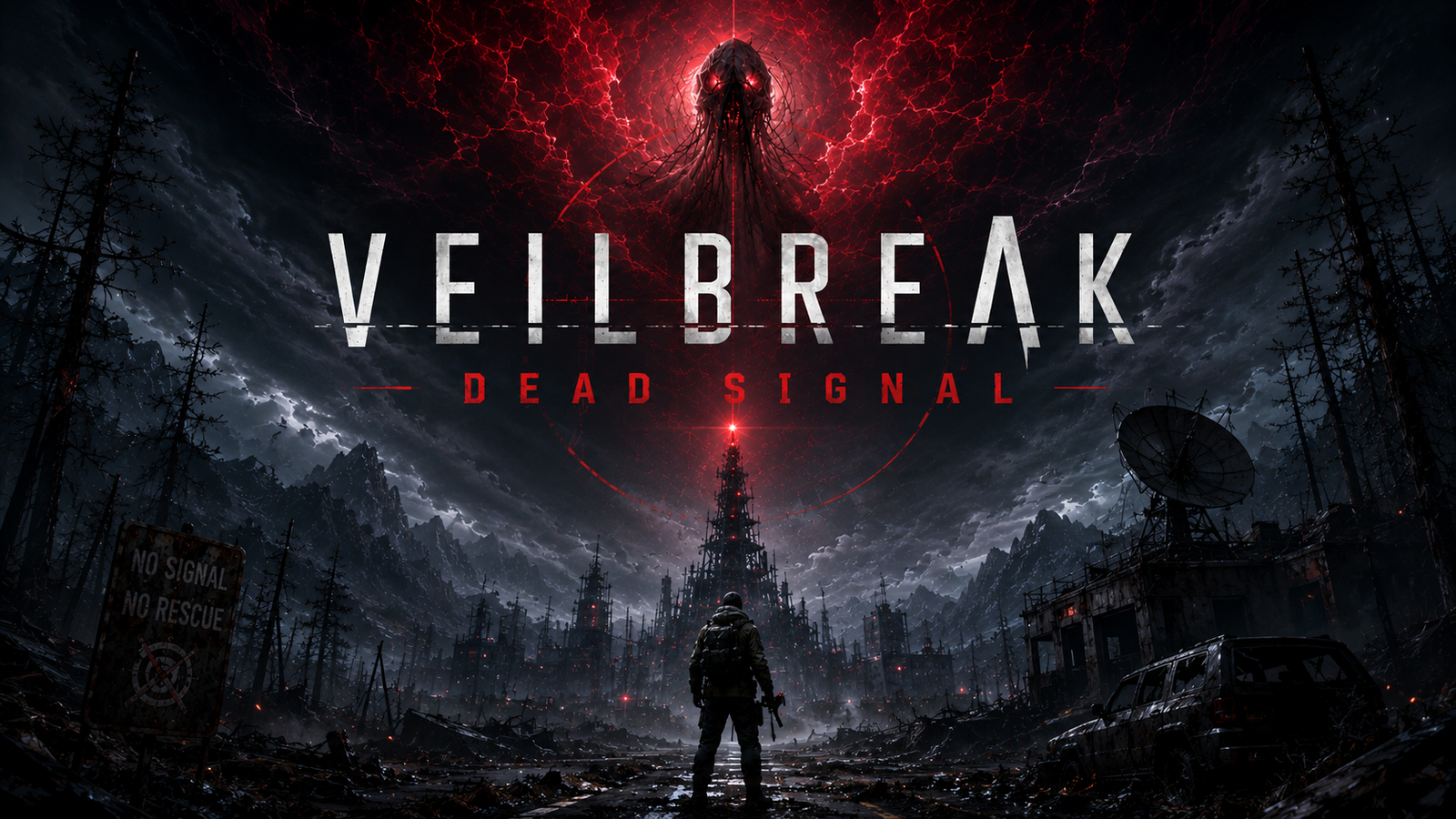
VEILBREAK: DEAD SIGNAL is a standalone round-based Zombies game built around handcrafted maps, escalating survival, story-driven Main Quests, unique crews, powerful weapons, and long-term progression. Following its public beta period, the complete game launches on November 5, 2026.
VEILBREAK is a dedicated Zombies experience built around handcrafted maps, escalating survival, story-driven Main Quests, unique crews, powerful weapons, long-term progression, and an expanding set of systems designed specifically for replayability. It is not trying to be every kind of shooter at once. Its purpose is clear: deliver a complete, standalone undead experience with its own world, tone, mechanics, and personality.
The beta is the foundation, not the finished product. Menus, progression, Oaths, maps, presentation, balance, and the wider visual language of the game are being refined for the November launch.
VEILBREAK // Overview
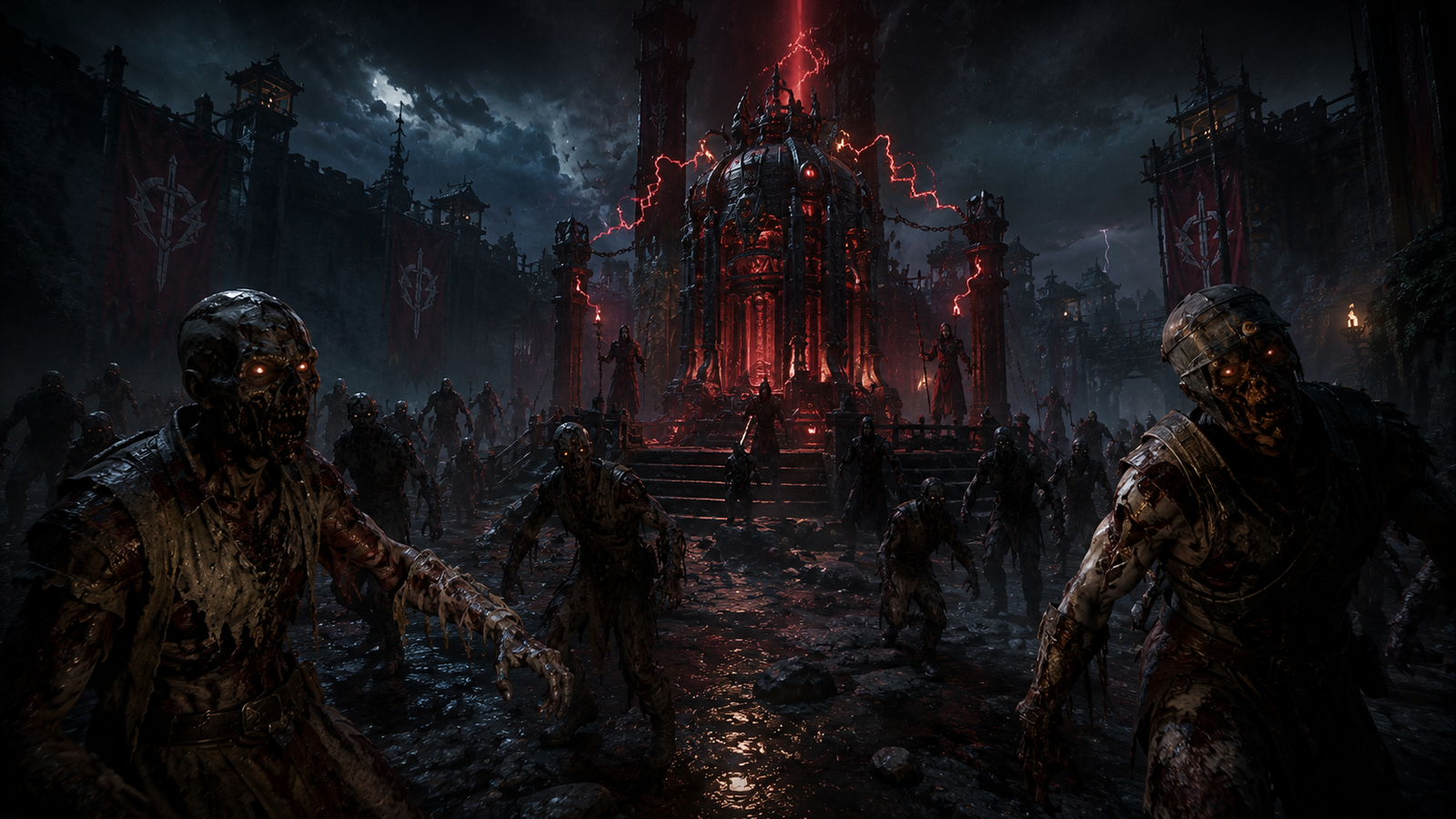
Reality is breaking at its weakest points. Across abandoned estates, fallen kingdoms, sealed laboratories, drowned ruins, and places that should no longer exist, the dead are returning through fractures known as Veilbreaks. These breaches distort the world around them, corrupting the living and pulling forgotten forces back into reality.
Every map tells a distinct chapter while contributing to a larger story. Players enter each location with limited resources, build their strength through weapons and Oaths, uncover the systems controlling the outbreak, and decide how deeply they are willing to descend into the mystery.
The foundation remains immediately understandable: survive the rounds, earn Essence, open new routes, activate the map, upgrade weapons, and complete objectives. Beneath that foundation sits a much deeper game of route planning, build creation, mastery progression, hidden encounters, optional challenges, and Main Quest discovery.
VEILBREAK is designed to reward both kinds of Zombies players: those who want to jump into a match and survive for as long as possible, and those who want to learn every room, solve every step, optimize every build, and master every map.
Zombies // Built as the Entire Game
VEILBREAK is not divided between disconnected Campaign, Multiplayer, and extraction experiences. Zombies is the game. Every major system, update, map, weapon, enemy, menu, and progression path exists to strengthen that central experience.
This focus allows each map to be larger in purpose without becoming bloated. A location can introduce its own rules, enemy set, Wonder Weapon, traversal, visual identity, hazards, Main Quest, music, and secrets without being forced into a structure designed for another mode.
Matches are built around deliberate escalation. Early rounds are about establishing routes and securing equipment. Mid-game rounds open build decisions, Oath combinations, Forge upgrades, and map-specific systems. High rounds push enemy pressure, resource management, positioning, and damage scaling to their limits.
Quest design follows the same philosophy. Objectives are meant to feel like actions inside the world rather than instructions floating above it. Important quest items remain visible through the dedicated Quest List, while exploration and environmental clues remain central to discovery.
Maps // Crownfall and Echoes of the Shadows
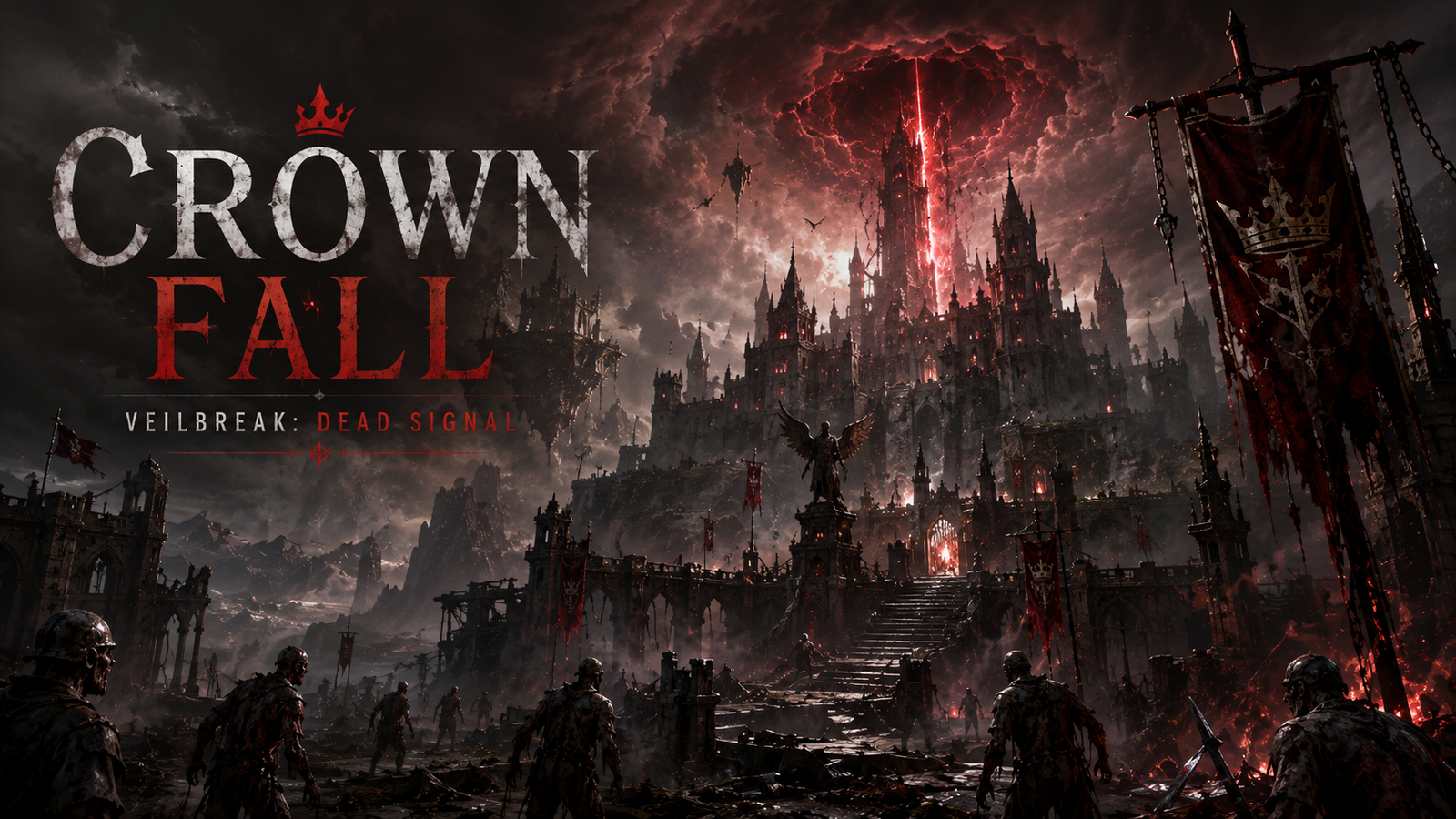
Crownfall
Crownfall throws players into the remains of a kingdom consumed by its own collapse. Once a symbol of power, the location has become a battlefield of ruined halls, exposed courtyards, buried chambers, and corrupted royal machinery. Its structure is built around readable routes, dangerous open spaces, and a Main Quest that steadily reveals what brought the kingdom down.
The map serves as one of VEILBREAK’s clearest expressions of traditional round-based survival: open the location, establish a reliable route, unlock stronger equipment, learn the enemy rhythm, and decide when to commit to the deeper quest.
Echoes of the Shadows
Set across the corrupted Voss Estate, Echoes of the Shadows is VEILBREAK’s most interior-focused map. The estate contains multiple floors, underground sections, rooftops, courtyards, hidden passages, and rooms designed with individual visual identities rather than a repeated grid.
Power is restored through four Conduit Rune defenses across the estate. The Forge requires players to locate hidden icons, survive lockdowns, collect transmitter components, and restore the route into the Umbra Sanctum. The map’s Main Quest follows the history of the Voss family, the ghost of Ilyana Voss, the Threefold Relics, and four character-specific Echo Trials.
Echoes of the Shadows also introduces Noah’s Superistic Folly, an infinite-ammunition pistol-based Wonder Weapon that fires explosive energy orbs through a heat and overheat system. It is woven directly into exploration, quest progression, and the final encounter.
Oaths // Perk Identity Rebuilt
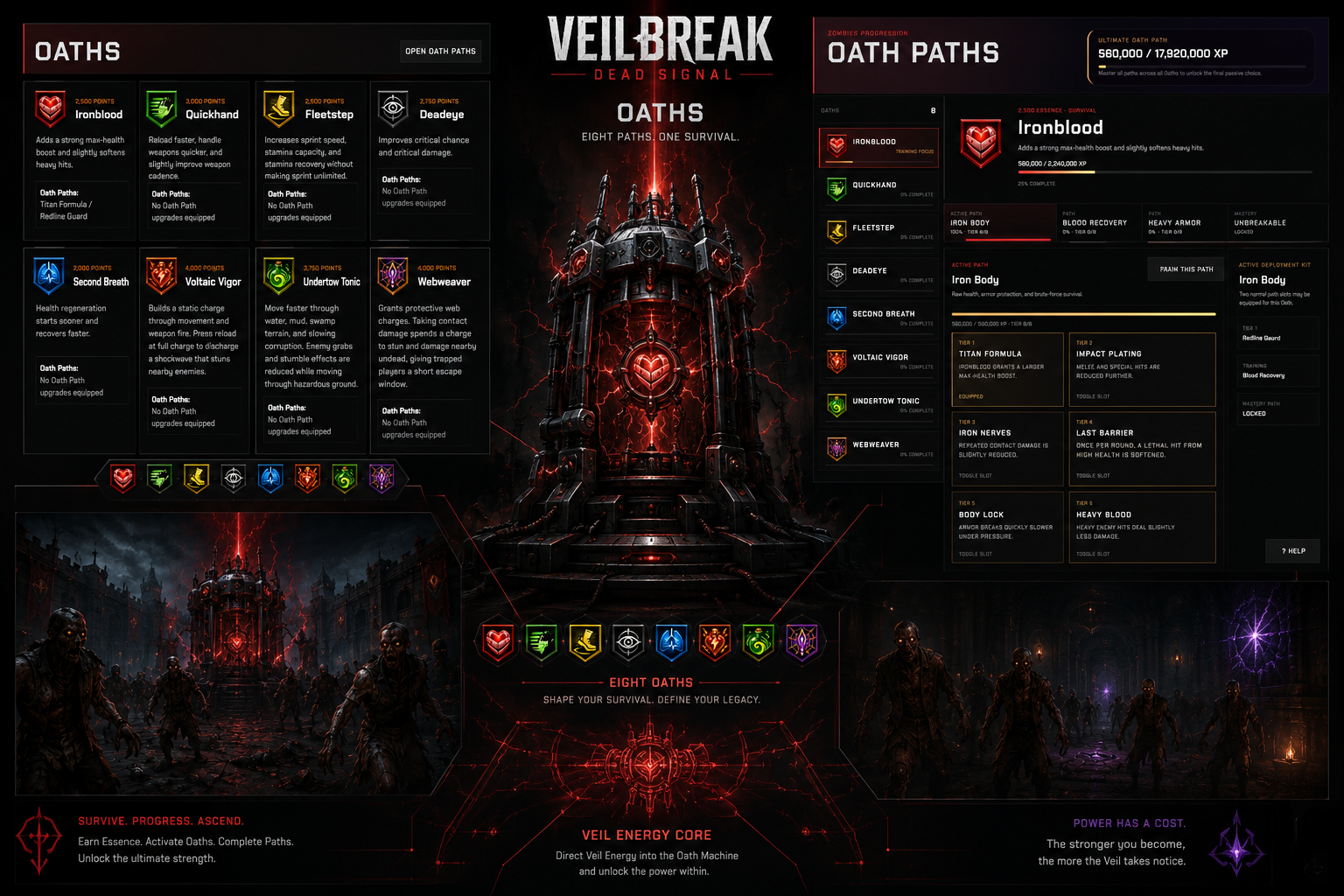
Traditional Perks have been rebuilt as Oaths, giving each upgrade a name, visual identity, gameplay role, and long-term mastery path unique to VEILBREAK. The goal is not to rename familiar effects and stop there. Every Oath is intended to feel like a distinct part of a player’s build.
- Ironblood strengthens survivability and damage resistance.
- Quickhand improves reload speed and weapon handling.
- Fleetstep expands movement freedom and sustained mobility.
- Deadeye rewards accuracy, precision, and critical damage.
- Second Breath improves recovery and revival capability.
- Webweaver introduces defensive control and entanglement effects.
- Undertow Tonic manipulates enemy movement and area control.
- Voltaic Vigor channels electrical power into aggressive combat effects.
Every Oath uses a dedicated arcade-style crest built to remain readable on the HUD at a glance. Colours, silhouettes, symbols, and effects are designed around the Oath’s actual purpose rather than relying on generic bottle art.
Oaths are purchased during a match, but their long-term potential is developed through Oath Trees outside the match. This gives players meaningful progression without turning the core survival experience into a menu-heavy RPG.
Oath Trees // Long-Term Mastery
Oath Trees replace the old Augment system entirely. Instead of choosing from a small set of generic modifiers, each Oath now has its own dedicated mastery tree with paths, tiers, unlocks, and progression milestones.
The structure gives every Oath room to specialize. Ironblood can develop around pure durability, emergency survival, or sustained recovery. Quickhand can lean toward reload speed, weapon swapping, or aggressive handling. Fleetstep can focus on sprint endurance, traversal, or evasive movement.
Players are not expected to unlock everything immediately. Oath mastery is a long-term system designed to continue growing alongside account progression, weapon mastery, challenges, and future content.
The menu itself has also been simplified. It focuses only on the information players need: Oath identity, effect, cost, unlock requirements, mastery progress, and available paths. Internal development explanations and temporary menu copy have been removed.
Weapons, Wonder Weapons, and the Forge
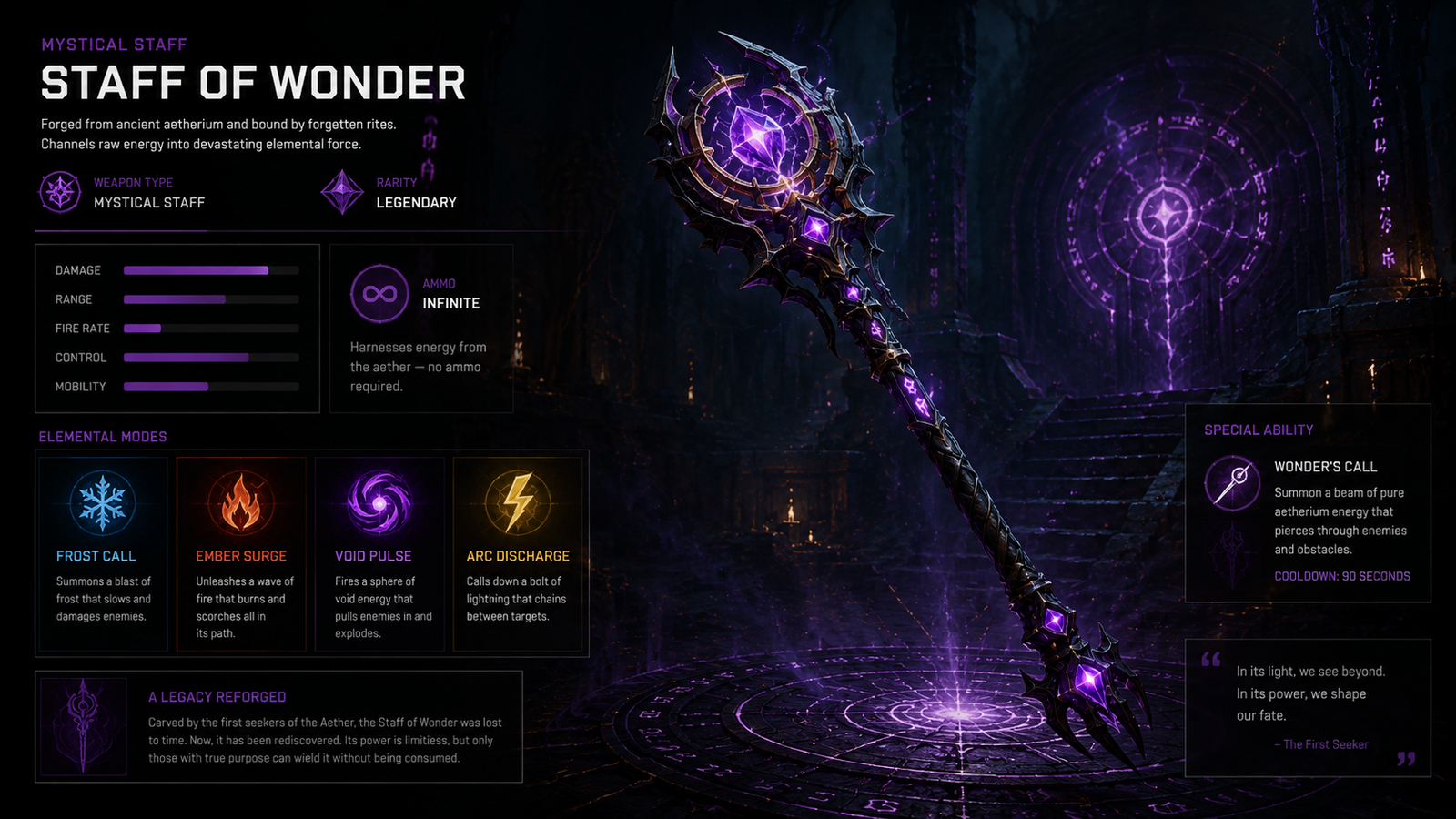
VEILBREAK’s arsenal is built around clear roles, readable upgrades, and weapons that remain satisfying as enemy pressure increases. Wall Buys provide reliable access to specific tools, while randomized weapon acquisition creates risk, variety, and the possibility of finding something exceptional.
Forge transformations are divided into multiple tiers, allowing weapons to remain viable as matches extend into higher rounds. Damage, ammunition, handling, and special properties can develop as a weapon moves through its upgrade path.
Wonder Weapons are treated as central pieces of each map rather than detached rewards. Weapons such as Noah’s Superistic Folly are designed around unique resource systems, visual effects, quest interactions, and strengths that cannot be replicated by standard equipment.
The broader armoury will continue to expand through updates, with new standard weapons, map-specific tools, equipment, Field Upgrades, and experimental weapons entering the game over time.
Modes // Different Ways to Enter the Outbreak
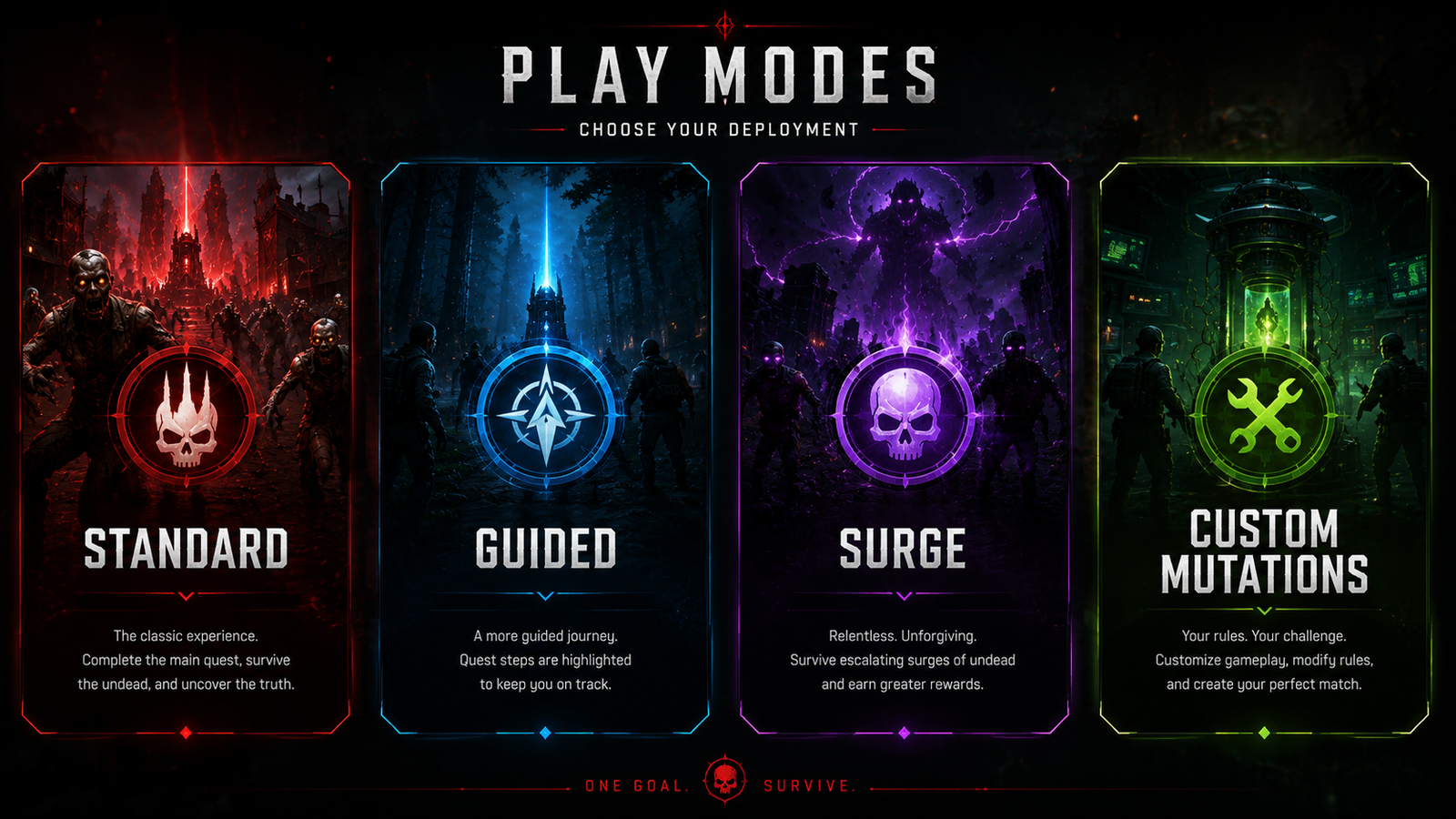
Standard
Standard is the complete round-based VEILBREAK experience. All map systems, Main Quests, side objectives, progression, and high-round survival mechanics are available without guided instructions.
Surge
Surge increases the pace and pressure of the match for players who want a more immediate combat challenge. It emphasizes fast setup, heavier enemy aggression, and quicker escalation without replacing the fundamentals of round-based play.
Guided Mode
Guided Mode provides structured assistance for Main Quest progression. It is intended for players who want to experience the map’s complete narrative and mechanics without relying on external guides, while still requiring them to survive and execute each objective.
Custom Mutations
Custom Mutations allows players to alter the rules of a private match, including starting conditions, enemy behaviour, friendly bots, and difficulty modifiers. Main Quests are disabled when mutation settings fundamentally change the intended map experience, and XP rewards scale according to the selected rules.
Enemies // More Than Increasing Health
The undead remain the foundation of every match, but enemy variety changes how players move, aim, prioritize threats, and control space. Sprinters create sudden pressure. Ranged enemies interrupt safe routes. Armoured and elite enemies force players to commit stronger weapons and abilities at the right time.
Map-specific enemies reinforce the identity of each location. Echoes of the Shadows features threats such as Doppelghasts, Hushlings, Runebearers, Veil Runners, Shadowbound, and the Abomination. Their purpose is not simply to add more health bars, but to disrupt familiar survival patterns.
Enemy health continues to scale into high rounds, but raw health is only one part of the challenge. Speed, spawn pressure, special attacks, positioning, and combinations of enemy types are equally important to how difficulty develops.
Progression and Customization
Progression extends across account levels, Prestige, weapon mastery, Oath mastery, challenges, cosmetics, HUD Themes, and map completion. The system is designed to provide meaningful goals without requiring players to abandon the maps and builds they enjoy.
Prestige rewards include exclusive visual unlocks and milestone-based HUD Themes. Weapon progression tracks long-term use and mastery. Oath Trees allow individual Perks to grow separately, giving players a reason to experiment beyond a single permanent setup.
Saving and profile systems preserve progress between sessions, while export support is planned to make progress transfer safer and more flexible. XP Tokens can be used across general progression, weapons, and Oaths.
The broader objective is simple: every match should contribute to something, even when the Main Quest is not completed and a high-round attempt ends earlier than expected.
HUD, Menus, and Presentation
VEILBREAK’s interface is being rebuilt to feel like part of the game’s world rather than a collection of temporary development screens. Menus use stronger hierarchy, cleaner spacing, clearer navigation, and a visual language consistent with the game’s darker arcade-horror identity.
The in-match HUD prioritizes visibility. Oaths, ammunition, health, objectives, power-up timers, and quest items must remain readable without covering the action. Large blocks of instructional text and persistent developer-facing explanations are being removed.
Map menus now focus on what players actually need before deployment: location, mission briefing, crew, supported modes, and progression. The PLAY flow is being simplified so players can select a map and mode without moving through several disconnected screens.
Story // Signals Beyond the Veil
VEILBREAK’s story is told through map openings, environmental detail, character dialogue, Main Quests, hidden intel, boss encounters, and ending cinematics. Each location stands on its own while revealing another part of the larger Dead Signal mystery.
Crews are written as active participants in the maps rather than interchangeable avatars. Echoes of the Shadows follows Elias Voss, Mara Vale, Jonah Creed, and Lena Wraith as the Voss Estate forces each of them to confront an Echo tied to identity, grief, memory, or guilt.
Completed opening and ending cinematics can be revisited through the Cutscene Viewer. Ending scenes remain locked until the associated Main Quest has been completed, allowing narrative rewards to retain their impact.
Additional VEILBREAK Intel Available
VEILBREAK: DEAD SIGNAL will continue to evolve through new maps, weapons, Oaths, progression systems, enemies, modes, quality-of-life updates, and story chapters. This page is the central overview of the game ahead of launch.
The beta period is being used to strengthen balance, clarity, stability, progression, and map flow before the complete release. VEILBREAK is being built as a focused, replayable, story-rich Zombies game with its own identity.
Development Credits
VEILBREAK: DEAD SIGNAL is developed and published by Mob Productions.
VEILBREAK: DEAD SIGNAL is currently in beta and will release in full on November 5, 2026.
© / ™ / ® 2026 Mob Productions.
For more information, visit veilbreakgame.com